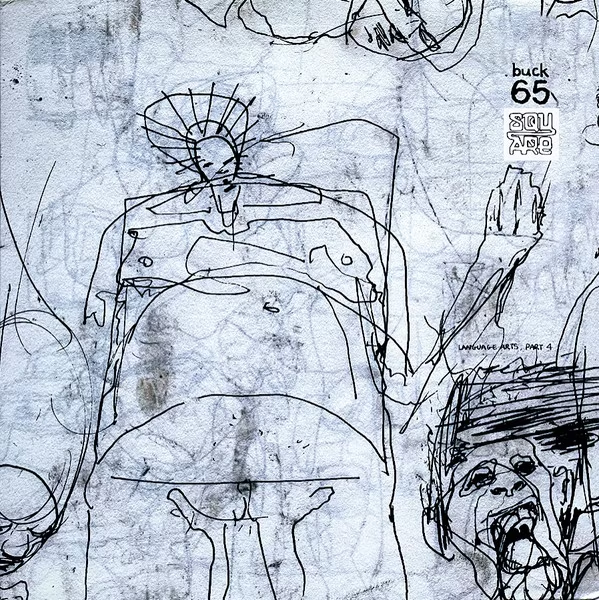
Released 2002 on Warner Music Canada (WEA)4 tracks over 61:03 minStudio Album
“I think Square has the best flow of all of them. A lot of planning went into it.”
— On the mixtape-flow quality of Square relative to the Language Arts series
Buck 65 Substack, 2022
“Those first few Scribble Jams were some of the best times of my life. It felt like the World Series or something.”
— Describing the early Scribble Jam events in Cincinnati
Buck 65 Substack, 2022
“I have this thing in me where elements of my songs, like the way my songs and albums are constructed, things have to be divisible by eight all over my record. Kinda like how the Greeks got obsessed with that Fibonacci Sequence, and everything had to be that way.”
— On his mathematical/structural obsession when constructing albums
Exclaim!, 2002
“It was a really hard song to write words to, a really big challenge. It's like being forced to use your left hand all of a sudden. Music has to make mathematical sense, otherwise it's an uncomfortable listen.”
— On writing lyrics for an odd time signature guitar sample on Square
Exclaim!, 2002
“Warner came to me rather than me going to them. I got a really good contract, because I have a really good lawyer. No compromise at all. Then Square comes out and it's weirder than ever.”
— On signing with Warner Bros. with full artistic freedom
Urban MVRemix, 2003
“The earth stood still. Years of wiring was suddenly undone as I realized for the first time that Stella Kuen was a real person. Instead of some monster, I saw the prettiest woman I had ever seen.”
— On discovering that Stella Kuen, used as a childhood epithet, was a real beautiful woman from South Uniacke, from Vertices substack January 2023
Vertices — Buck 65 Substack (buck65.substack.com)
“Lots of attention to detail here. I took more time with this record than any previous. It's the most musical of my records so far, I think.”
Exclaim!, 2002
1 / 7
Release overview
Transitional album. Originally made in 2000, held back for a long time before release (as Terfry was touring constantly between 2000-2003). Released on WEA (Warner) in 2002. Precursor to Talkin' Honky Blues. Described as especially abstract, 'arranged like a square for maximum vinyl compatibility' — four songs, each on one side of a vinyl record.
Made circa 2000, released 2002. Buck 65 was touring non-stop during the gap between creation and release. The album was held while he was 'on stage every night.'
Square was originally made in 2000 but held for approximately two years before release. Buck 65: 'I made Square originally in the year 2000, I think, and I just sat on the album for a very long time before it was released. Between 2000 and 2003 (when Talkin Honky Blues came out), I was touring the entire time. On stage every night.' The album essentially documented a moment in his creative development that the audience didn't encounter until he had already moved on.
Square is the first Buck 65 album recorded on digital equipment — specifically the Yamaha MD-8 digital 8-track (MiniDiscs), replacing the cassette 4-track used on everything up to and including Man Overboard. He reports hearing the difference in the sound. The transition from cassette (Language Arts, Vertex, Man Overboard) to digital (Square onwards) marks a threshold in his recorded sound. DJ Signify made 'four or five' of the beats on Square — they met at Scribble Jam 1998 or 1999 in Cincinnati. Graeme/Graymatter (Halifax roommate on Maynard Street) helped record Square technically and as co-producer. A cassette with the full instrumental version of Square exists — ripped and posted on Bandcamp. Square confirmed as 'the fourth album in the Language Arts series'.
Square was the first Buck 65 album recorded on a digital 8-track using mini-disks, moving away from the 4-track cassette tape format used on all prior albums through Man Overboard.
Square was the fourth album in the Language Arts mixtape-flow series. Buck 65 considers it to have the best flow of all albums in the series. He meticulously mapped out the structure and still has the planning notes in an envelope.
Charles Austin first played guitar on a Sixtoo track with P.E.A.C.E. from Freestyle Fellowship. Impressed by his taste, Buck 65 enlisted him for "Pack Animal" (recorded for the Japanese compilation Tags of the Times), then expanded the collaboration to Square. This began a long-standing working relationship.
DJ Signify, whom Buck met at Scribble Jam in Cincinnati around 1998 or 1999, produced four or five beats on the Square album. They became close friends and would talk on the phone for hours. Buck later lost touch with Signify and could not locate him.
Square was recorded at a house on Maynard Street in Halifax. Buck 65's roommate Graeme (Graymatter) helped with recording on both technical and production sides. They worked together for many years afterward.
Square was recorded in late 1999 but not released until 2002 due to delays related to the Warner record deal. It was the first album after signing but was not part of the Warner deal since it was recorded before the contract.
Square was released on Warner Bros. in October 2002 as Buck 65's first major label album and Language Arts Part Four. It was recorded using his SP-1200, a 4-track recorder, turntables, and a Shure SM58 mic. DJ Signify co-produced some tracks — the first time Buck 65 allowed another producer on his album.
Square marked a significant shift in Buck 65's influences, moving from hip-hop toward Tom Waits, PJ Harvey, Portishead, Simon & Garfunkel, David Lynch, Robert Frank, and Charles Bukowski. His voice became gruffer and more sing-songy, with doubled vocals on some tracks.
The Stella song on Square was inspired by Stella Kuen, a real person from South Uniacke, the poorest part of Mount Uniacke, Nova Scotia. Children used her name as an epithet; Buck 65 was shocked to discover she was real and beautiful. The song addresses small-town prejudice. After Square's release, a relative of Stella approached Buck 65 at an in-store to thank him, which terrified him about emerging from underground obscurity.
In summer 2002, Buck 65 signed a four-album deal with Warner Music Canada. The deal included releasing Square and reissuing his entire back catalogue (including a reworked Synesthesia). Warner suggested he move to Paris to be closer to his European market.
On Square, Buck 65 moved away from his alter-egos (Johnny Rockwell, Uncle Climax, DJ Critical) toward a more sketch-based storytelling approach. The album features more singing and doubled vocals. One track uses a guitar sample in a different time signature, forcing him to adapt his math-based writing to non-standard counts.
By 2002, Terfry's influences had shifted dramatically from hip-hop to Tom Waits, PJ Harvey, Portishead, Simon & Garfunkel, David Lynch, Robert Frank, and Charles Bukowski. He admitted: "I don't listen to [hip-hop] at all anymore."