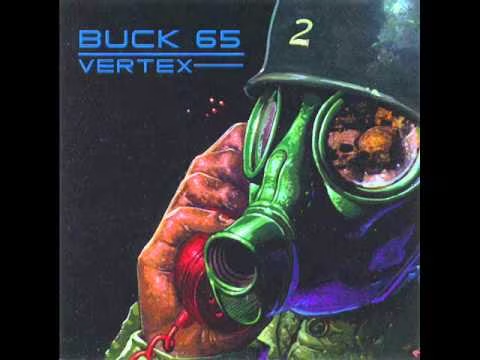
“I'd make a beat, record it to tape, delete that beat from the SP and then start building the next beat. Everything was desperate measures.”
— Vertices Substack, 'Vertex' post (June 2022). Describing his SP-1200 workflow during Vertex — beats were recorded to tape and immediately deleted from the sampler. The result: every beat on Vertex is a lost recording, unreproducible by its creator.
Vertices — Buck 65 Substack (buck65.substack.com)
“I woke up feeling inspired one morning and worked for two days straight with no sleep or food. I wasn't just focused. I went into a flow state or some kind of trance.”
— Vertices, 'Green X — Who was that guy?' (March 2026). On the Vertex recording sessions.
Vertices — "Green X — Who was that guy?" (March 4, 2026)
“I didn't have any disks for the sampler to save any of my beats. After I laid each one down, I cleared the memory and started again.”
— Vertices, 'Green X — Who was that guy?' (March 2026). On the SP-1200 workflow during Vertex.
Vertices — "Green X — Who was that guy?" (March 4, 2026)
“It's a shame I wasn't able to see that it was actually the best time of my life.”
— Vertices, 'Green X — Who was that guy?' (March 2026). On the Vertex period.
Vertices — "Green X — Who was that guy?" (March 4, 2026)
“As I've been making music in a frenzy over the last four years or so, I've been trying to find a way back to that apartment — to feel its cold drafts and to smell the cat piss again.”
— Vertices, 'Green X — Who was that guy?' (March 2026). On the creative drive behind the 2022-2026 renaissance.
Vertices — "Green X — Who was that guy?" (March 4, 2026)
“I remember making the conscious choice to mostly sample Canadian records — just as a challenge, I guess. It wasn't a pride thing.”
— Vertices, 'Green X — Who was that guy?' (March 2026). On sample sourcing for Vertex.
Vertices — "Green X — Who was that guy?" (March 4, 2026)
“I marvel now over the clever ways I made the most of my eight seconds. And my ability to find a dope loop hidden within the grooves of some of the worst records ever made was monk-like.”
— Vertices, 'Green X — Who was that guy?' (March 2026). On the SP-1200 8-second sample limit.
Vertices — "Green X — Who was that guy?" (March 4, 2026)
“Having all the guts of Vertex laid out on a nice grid in Ableton, it feels very tempting to pull out the chainsaw. But I won't let myself do it.”
— Vertices, 'Green X — Who was that guy?' (March 2026). On the instrumental mix preparation.
Vertices — "Green X — Who was that guy?" (March 4, 2026)
“Vertex has followed me around my whole life. I was confused by the fuss at times. But I think I get it now.”
— Vertices, 'Green X — Who was that guy?' (March 2026). Final line of the post.
Vertices — "Green X — Who was that guy?" (March 4, 2026)
“The "emo" backlash was very deflating. The criticism was so succinct. One word: "emo". It was a total dismissal.”
— Describing the critical reaction to Vertex and its personal, confessional lyrics
Vertices — Buck 65 Substack (buck65.substack.com)
“I think those songs and the reactions to them ultimately led to entire albums like 20 Odd Years and Neverlove, both of which I now find to be unlistenable.”
— Tracing the line from Vertex's confessional songs to later albums he regrets
Vertices — Buck 65 Substack (buck65.substack.com)
“No other record I ever made creates a world as distinctly and vividly as Vertex does.”
— Acknowledging Vertex's strength as atmosphere and mood
Vertices — Buck 65 Substack (buck65.substack.com)
“I have no memory of making this record whatsoever. It's possibly my best work, but it makes me feel strange to listen to it.”
— Self-assessment of Vertex for the Exclaim profile
Exclaim!, 2002
“I made Vertex in two days, just going nuts, burning the candle at both ends, basically like: "I'm just gonna make this goddamn record." I think it really captured some energy.”
— Confirming Vertex was recorded in two days
Buck 65 — HipHopInfinity interview (2001)
“I have no memory of making this record whatsoever. It's possibly my best work, but it makes me feel strange to listen to it.”
One of his most acclaimed early albums. Fan community considers 'The Centaur' from this album as a joint all-time top track. Represents the peak of his Language Arts / abstract period. Recorded with no vocal compression — SM58 straight into the cassette 4-track. Buck 65: 'Vertex is a séance.'
Released on Four Ways to Rock/Metaforensics. Self-produced. Recorded on home cassette 4-track, no compression on vocals, SM58 mic direct to recorder. All tracks sourced from the SP-1200 sampler. Notable samples: The Centaur samples the 1976 film Carrie; Slow Drama uses a French translation of an Edgar Allan Poe quote sourced from a record; Style #386 (final track) samples 'Absolute Elsewhere'. Buck 65: 'Vertex is a séance.'
'The Blues' appears in three parts across Vertex (The Blues Part I at track 5, The Blues Part II at track 11, The Blues Part III at track 17 out of 18 tracks). This is a structural precedent to the Riverbed split-narrative technique on Talkin' Honky Blues (2003), where 7 Riverbed parts are interspersed across the album. Vertex: three-part arc. THB: seven-part arc. Both use a recurring titled series as connective tissue. The pattern appears to be a conscious compositional signature, first used on a 2000 record and refined on a 2003 one. Also from the Paris mailing list: 'Vertex is a séance' — a single-word conceptual frame for the album's atmosphere.
On Vertex, Buck 65's vocals had no compression whatsoever. June 2002 mailing list (full gear spec): 'On everything up to Vertex, I didn't even have any compression on my vocals.' And from the Paris interview: 'my voice wasn't even compressed. Just my mic plugged directly into my 4-track.' The Shure SM58 ran straight into the cassette 4-track. No preamp. No compressor. No EQ. The rawness of the Vertex vocal sound is not an aesthetic choice made in post — it is the absence of any processing at all.
The original 4-track cassette recorder used to record Vertex ended up in the hands of Skratch Bastid (Canadian DJ). Skratch Bastid offered to sell it back to Buck 65 at some point — he declined. He now regrets this: 'That was a dumb mistake. I suppose I could try to find a used one for sale somewhere but the last time I saw one, it was quite expensive.' This means the original Vertex tape(s) may still be associated with this recorder, wherever it currently is. No instrumental version of Vertex was ever bounced: 'I'm almost positive I never bounced an instrumental version.' Plans as of December 2024: reconstruct an instrumental from scratch by digging through his record collection to find the original source material.
Every beat on Vertex is a permanently lost recording. Buck 65's SP-1200 workflow at the time: make a beat, record it to tape, delete the beat from the SP, build the next beat. He had no backup, no hard drive, no save states — just tape as the only capture. Quote: 'Everything was desperate measures.' When the tape ran and the beats were recorded to the cassette 4-track, the SP-1200 was wiped for the next beat. The recorded masters exist on tape (hence the album exists) but the beat data — the loop structure, the samples, the arrangement — is gone forever. Vertex cannot be reproduced, deconstructed, or remixed from its source material.
Vertex was recorded in 2–3 days without sleep, food, or breaks — continuing until the process 'got psychedelic.' Living conditions: 'My apartment smelled like cat pee.' He was estranged from his family and post-breakup. No vocal compression (SM58 direct to cassette 4-track, as separately confirmed from the June 2002 mailing list). Buck 65's own frame for the album: 'Vertex is a séance.' The condition of isolation, sleeplessness, and psychedelic duration under which Vertex was made is inscribed in the album's sound — the raw vocals, the spatial quality of the beats, the album's uncanny consistency of mood. Also confirmed in this post: Vertex contains musique concrète elements (he names it explicitly).
Vertex was pressed on vinyl exactly once: 2013, 500 copies. Ten of those copies had no printed sleeves — Buck 65 made handmade sleeves in his basement from tour photos and rhyme book pages. These 10 copies are unique objects: one-of-a-kind artefacts assembled from the personal ephemera of the person who made the album. The tour photos and rhyme book pages used for the sleeves are primary documents of his working process, now physically attached to the album's vessel.
During the Vertex period, Buck 65 lived on a recipe from his first girlfriend Francine's grandmother — the cheapest macaroni boiled with a can or two of vegetable soup. A batch lasted three days. First mention of Francine by name. The recipe is a precise poverty marker connecting his creative output to material deprivation.
Buck 65 made a conscious choice to mostly sample Canadian records for Vertex — a self-imposed creative challenge, not nationalism. Combined with dollar-bin records and the SP-1200's 8-second sample time limit, this triple constraint shaped the album's sonic character.
In early 2026, Buck 65 digitised the original 4-track master tapes for Vertex and began preparing an instrumental mix. The tapes show signs of degradation after ~30 years. He describes the process as 'performing an autopsy.' Working in Ableton but guided only by his original mixing notes from an old notebook, refusing to modernise the material.
As of March 2026, Buck 65 is preparing a Vertex instrumental mix from the digitised 4-track tapes. He says he will be 'sharing it soon.' Listening to the beats stripped of vocals and turntables revealed their quality.
1 / 11
Release details
beats, cuts, rhymesRichard Terfry
Track 1 of 18
Sounds From the Back of the Bus
0:00 / 4:04
The Centaur
0:00 / 2:31
'The Centaur' (track 2 of Vertex) samples the 1976 Brian De Palma film Carrie. This places the track within a tradition of hip-hop horror film sampling. The Centaur is also the title of a separate single (1999 — 'The Centaur / 15 Minutes to Live 12'''), suggesting this character/concept preceded its appearance on Vertex.
'Slow Drama' (track 7 of Vertex) uses a French translation of an Edgar Allan Poe quote sourced from a record. The use of a French-language Poe translation (rather than the English original) is characteristic of his approach — finding the obscure path to canonical material.
“Much of my best writing has been done in lucid, almost trance-like states that I can't really explain. Sometimes I'll wake up in the middle of the night and start writing frantically. Sleep Apnoea was written in five minutes — almost freestyle. By the way, I've never done drugs.”
Vertex contains a cover of a Roxy Music song. Buck 65 described all things Roxy Music as brilliant and the song 'In Every Dream Home a Heartache' as his introduction to the band, calling its lyrics 'some of the best I ever heard.' He expressed hope that Brian Eno would appreciate his work.